There’s this phrase that has been bouncing around in my head this week: reading is for contentment. I came across it revisiting a passage I particularly liked in a book by The School of Life on how to live a simpler life. The premise stuck with me. Maybe, just maybe, we could be reading less, not more. Contentment is a concept you can’t pour more into, it’s already full on its own. It is about what you already have, where you already are.
I was one of many who got sucked into the TikTok-ification of reading. By this, I mean the pervasive feeling that reading has become a competitive sport, the pressure to post about your reading statistics, and perform your taste. (If you read a book in the middle of the woods and nobody is around to see it, or you don’t post about it on Goodreads, does it count as reading?) Personally, I became a bookworm to avoid competitive sport, anything pertaining to math and performing in drama classes at school. Reading was my safe place. Somewhere along the line, my reading became crowded out by the voices of ‘more, more, more!’ and I lost the deep way that I grew to read as a child.
Gretchin Rubin, the author of The Happiness Project, wrote that she felt silly being an adult that liked to read (and re-read) children’s literature. Until she discovered other like-minded folk who wanted to read the same stuff. Emboldened, she started a book club for adults who exclusively read children’s books. I had a similar discussion with a patron in the library this week. She plopped a whole pile of children’s chapter books onto the counter and said, ‘just so you know, these are for my son.’
I said, ‘I wouldn’t judge you if they weren’t, I love reading children’s books.’
She laughed and said, ‘Well I have actually been enjoying re-visiting classics, like Anne of Green Gables, recently.’
‘I love that! Like Little Women, too?’ I said.
She lit up and started to tell me about the classics she’s been reading.
More and more, I’ve been pondering how to re-capture that distinctive joy in reading; that childlike delight. I’d been focusing on the wrong things: How can I finally read a hundred books this year? (I have never cracked that number.) Instead of questions like: How can I really enjoy my reading this year?
I have found, oddly enough, that my mid-twenties has been a period of re-enchantment. For a while I tried living in the soul-suck of disillusionment, such as keeping up with politics (which only makes me more depressed). But I’ve begun rediscovering what made me light up as a child and clutching onto those things tightly once I’ve found them.
My late teens and early twenties was, what I like to call, my Persuasion-era (Jane Austen fan, anyone?). The Persuasion-era is that time in life which Captain Wentworth would describe as so despicable of young ladies who are not of ‘strong mind’. Those who were willing, or amenable enough, to have their own opinions persuaded by others.
I tried on almost everything in this time of my life. I followed each and every whim to its conclusion, until I figured out whether it was something I really wanted or not (like being a vegetarian for seven years. At first, it was merely to see if I could, and then I continued out of sheer stubbornness). This year, I’ve begun to read again in the way that I have always loved.
Some of my favourite memories when I was young was going down to my sunny local library and plucking out books from the shelves. My favourite section was the historical biographies, mythology and World War I books.
When I was twelve, one of the most memorable books I found was The House by the Dvina: A Russian Scottish Childhood by Eugenie Fraser. (I’ve had an itch to re-read this one for a while now.) It was so good, that when I found a secondhand copy of it in an opshop, I begged my mother to buy it for me for the price of one whole dollar. When I was thirteen, I found Forgotten Voices of the Great War by Max Arthur in the 900’s section and took extensive notes for no reason other than my own enjoyment. Back before I got ‘too busy’ to contemplate such an exhaustive exercise, I would pen pages and pages in my pre-teen hand on whatever took my fancy for the pure pleasure of it.
I get this from my mother, I think. She’s a keen user of the ‘Commonplace Book’ method. Every book she reads has quotes carefully copied out and reflected on in her journal. Anyone who has attempted this method knows it is no mean feat. It is a labour of love. At some point, I began to see this deep engagement I had cultivated in my own reading as too time consuming. How can I bring this sense of abounding timelessness I felt in my youth into my present? I think by slowing down the way I read.
Sure, in different seasons of life, we have different amounts of time to read. But there are snatches of the day I can stow away a moment to read and copy out a beloved quote. When it brings me so much joy, how could I deny the call? No, I won’t be reading a vast number of tomes this year, but each book is going to etch its way onto my heart.
I’m not the only one getting off the book apps; the hype-train. Jenny Fern has a fascinating video on the subject. She says some things which I found to be quite profound, and comforting, too.
Fern says,
‘I am really thinking a lot more about being a human and doing things that make me feel more in touch with humanity and I was finding [in] using these various apps and websites, that my humanity was not being fully honoured or recognised.’
She laments the things we can do as a human that these apps cannot, like starting the year on a random date, engaging with reading that is not in a book (articles, short stories or fan-fiction, for example), or enjoying an experience without doing the mental gymnastics required to ascribe it with numerical value. Or the fact that, on the book apps, re-reading doesn’t count because that book only counts as one and you’ve already read it (?!).
There is a particularly delightful phrase she uses: ‘There are these squishy elements to reading that I think we lose when we decide to use these apps.’
Squishy elements.
I love it.
It made me think about that phrase: the medium changes the message. Bookish apps did change reading for me. It became about goals, not pleasure. Numbers not experiences. I stopped reading deliciously descriptive historical novels over 500 pages because a 200-page book could be finished faster. I put dense classics to the side in favour of shorter, snappier works.
All for the algorithm.
I remember reading, 21 Lessons for the 21st Century, by Yuval Noah Harari when it first came out in 2018 and thinking the author needed to chill out for pronouncing that the divine authority once enjoyed by deities and kings would be replaced by Big Data algorithms. I rolled by eyes, but kept reading. But, dear reader, he was right. The drama of human decision making is changing in the face of algorithms and data. I was determined to be above such pervasive data mining, and yet, years later here I am, changed by it.
I remember one sentence of Harari’s that scared me: ‘Within a few decades, Big Data algorithms informed by a constant stream of biometric data could monitor our health 24/7.’ And then recommend you solutions with artificial intelligence. No way, I thought to myself. That’s too dystopian.
And yet…
In order to buy a house, my fiancé and I had a meeting with a broker about personal life insurance. The broker tried to sell us on a modern solution whereby you could get a five-dollar voucher off your groceries if you could complete certain health goals every week (your FREE Apple Watch would track it all for you! Your daily steps, your heartrate, everything! Pay off your mortgage quicker if you let a data-hungry company leech every intimate detail from you by living on your arm – even when you sleep!). Yikes.
I, personally, am so opposed to this Orwellian surveillance, yet I would meticulously record my statistics every time I got that I-just-finished-a-book rush. My reading habits had quickly slid, without my notice, into a realm I neither valued nor wished to visit.
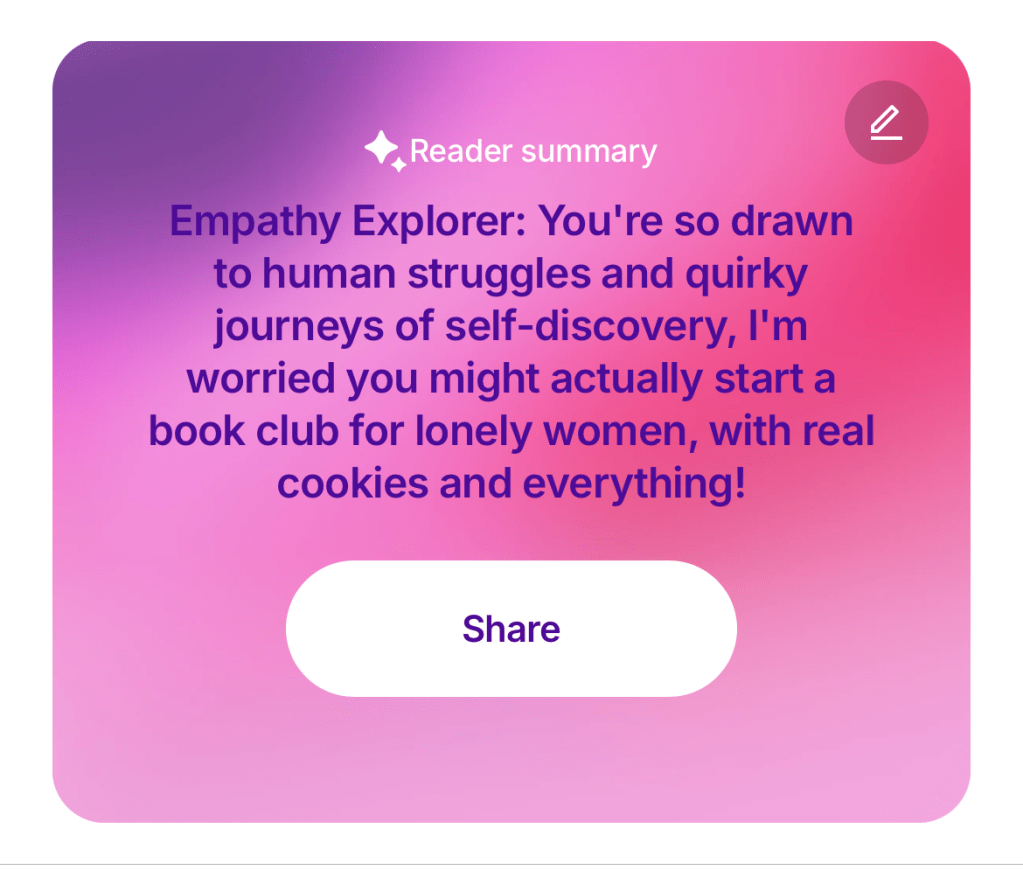
(Not to mention the time that I gleefully signed up for the newest book app – Fable – and got burned by the AI summary. And, while I’m digressing, no shade to Storygraph. I still use that at work for the valuable data about trigger-warning topics when I’m recommending books to teenagers or sensitive people like myself. Every shade imaginable to Amazon, though.)
Marissa Levien talks about this in her wonderful article, ‘What We Lose When We Gamify Reading’.
She writes: ‘we are addicted to data and intent on improving ourselves over enjoying ourselves’. That hit me hard.
I want to enjoy myself.
I want to give books the chance to ‘burrow into my heart’, as Levien writes. I want to be surprised by strange books, experience every book (and not forget them the next week because I binge read them), savour every sentence, copy out the pages that capture my heart. I want to gain back the ‘art of reading slowly’ (doesn’t Levien write so beautifully? I cannot recommend the full article enough).
Preaching at you is not my aim here. My passion is for my own project. I’ll still be recording the books I read, but the number will no longer be the focus. I still love reading goals (heck, even the goals at the library for children rock! Like reviewing eight books to a librarian and getting a free pizza). But I’m off the book apps for good.
Last year I finished the herculean task of transferring my combined Storygraph, Goodreads and Fable data to my Notion book tracking spreadsheet. Smugly, I thought, I’m off bookish social media. Yet I was still tracking myself.
Now, I am embracing commonplacing. (If you want to learn more about that, check out this blog post from Miranda Mills.) I am remembering what it was like to randomly discover a book. To get a personalised recommendation from a real person rather than be pushed one by an algorithm. I am deeply engaging with what I am reading and leaving time to stare out the window and ponder the page I’m on. I’m diligently copying out the most meaningful quotes like I’m a teenager again. I’m re-reading old favourites.
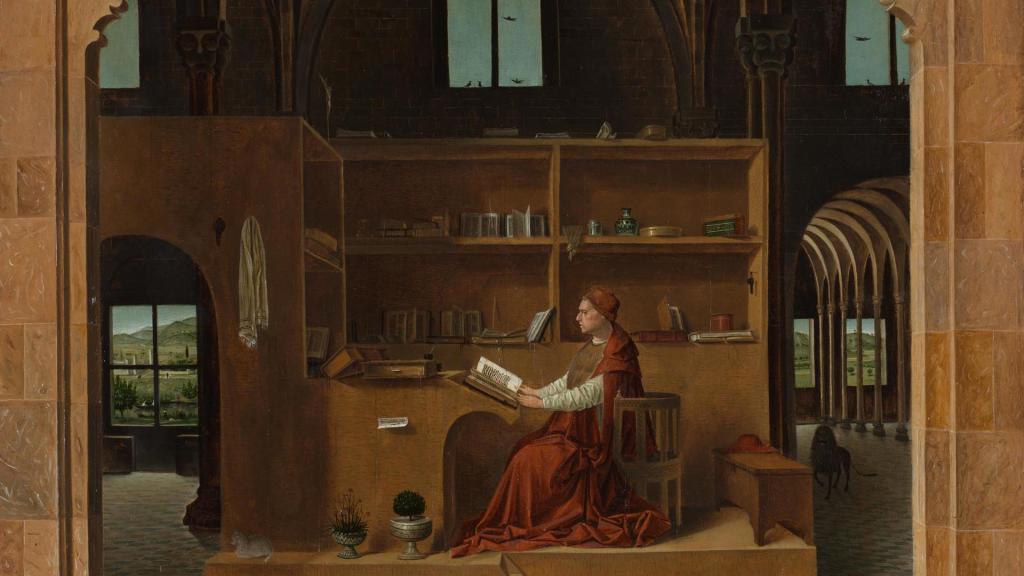
St. Jerome, the patron saint of librarians and libraries, is depicted in a painting by Antonello da Messina as only owning around ten books.
Ryan Bartaby, in The School of Life’s A Simpler Life book, writes that, ‘The truly well-read person isn’t the one who has read a gargantuan number of books, but someone who has let themselves, and their capacity to live and die well, be profoundly shaped by a very few well-chosen titles.’
It’s a good reminder that reading for enjoyment – reading for contentment – is about how we read. Not how many.
The Laid Back Librarian x
 The Laid Back Librarian
Leave a comment