I wrote this article exactly two years ago, in July 2024. I will be writing a “How is my digital detox going?” article soon, reflecting on a year of getting rid of many of my social media platforms.
Maybe you’re like me and are looking to strike that sweet spot where we’re not feeling like sh*t all the time on social media, or being driven by the search for dopamine spikes, and you’re asking yourself: can a calm equilibrium be found? (A techquilibrium?)
Remember when Zendaya said in an interview for Spiderman: Far From Home that she had too many tabs open in her brain?
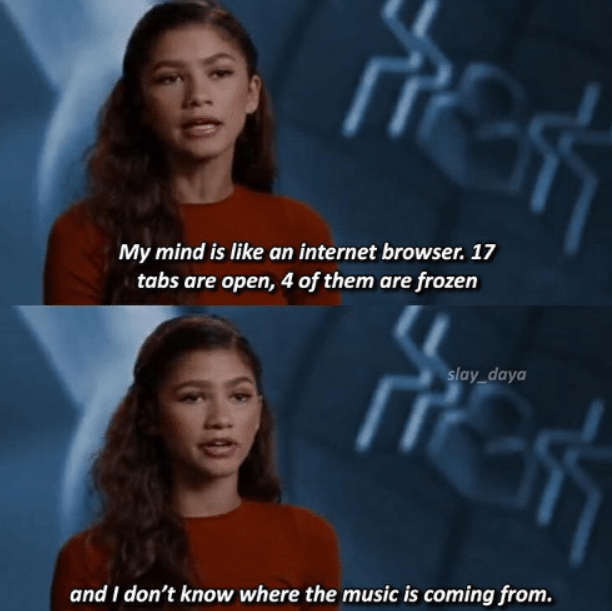
With all the doomscrolling, overwhelm, comparison, compulsion to stay current (hello FOMO), celebrities and influencers trying to, well, influence me, I was starting to feel like some places on the internet were becoming bad for my brain. So recently I closed a few mental tabs, metaphorically speaking. I deleted my accounts from Instagram and TikTok, and took the Facebook app off my phone.
Sure, you’re thinking, who cares. Yet as a Gen Z, it feels a bit nuts to not have that little green active dot beside my name all the time. It’s a bit like cutting off an extension of myself; not of flesh and blood, but of social capital and other abstractions. That’s not to say I’m the only one my age with these qualms ⸺ far from it. The Pew Research Centre found that Gen Z is the only generation where there have been declines in social media usage.1
What is different about Gen Z, and those born after, is that we didn’t have a significant choice about being on social media. It became pervasive by the time we were first chomping at the bit to jump online (when we were tweens and teens). Life was different for those of us growing up online, especially after the iPhone made its debut in 2007. Sociologist Sherry Turkle expands on how it is for kids growing up now:
…we now rarely give each other our full attention… We forget how unusual this has become, that many young people are growing up without ever having experienced unbroken conversations either at the dinner table or when they take a walk with parents or friends. For them, phones have always come along.2
Phones are the new spectral presence. (There’s even been research that people experience “phantom” buzzes: they think their phone has gone off, and when they check it, nothing’s there. A horror film where the haunting is not a ghost. It’s your phone.) Even more terrifyingly, Turkle adds: “By now, several ‘generations’ of children have grown up expecting parents and caretakers to be only half there.”3
I don’t want to be half there when here is all we get.
Surely, the biggest amount of FOMO I could ever feel is missing my own life because I didn’t look up. Attention is the hottest commodity today; but on the flip-side, we’re all poor on presence. I’m not saying this to send you (or myself, for that matter) into a techno-panic tailspin. Rather, I want to reflect on my own smartphone usage, and also society’s.
Social media and smartphone usage is not just a matter of self-discipline, it’s a systemic issue that needs to be examined on a wider scale. When my sister was editing this article, she commented: “social media/smartphones are designed to be like crack for our brains. You wouldn’t expect an addict to just have self-discipline – why do we expect this of tech?” And I think she’s a genius. So I’m going to expand on this analogy.
We don’t expect substance abusers to go it alone; there are AA (Alcoholics Anonymous) groups and rehabilitation centres. We know, statistically, it’s an issue that will affect many of us: there are nearly 1 million New Zealanders who are drinking dangerously.4 In a country with a population of just over 5 million, that’s around 20%(!). Wew. Journalist Guy Espiner (please go read his book, it’s incredible), has found that “[t]he alcohol industry has successfully pushed the idea that problem drinking can be managed with ‘personal responsibility’.”5
“Drink in moderation” is simply a slogan slapped on a can. In a perfect world, personal responsibility would be enough. But in our world, alcohol use feels good (like those hits of dopamine devices give us). Drinking is a way to go “off-line”, in that it disengages the prefrontal cortex.6 Like your phone, drinking provides relief, distraction, and floods you with dopamine.
There are systemic changes that help manage excessive drinking: “increasing the price (e.g. through excise taxes [that are levied to discourage the consumption of a product and paid by the business]); regulating physical availability (e.g. through restrictions on trading hours and alcohol outlet density); and restricting marketing and [sports] sponsorship”.7 (“Alcohol outlets” is just a fancy-government-report-way of saying liquor stores being in distance of things they shouldn’t really be available around, i.e. maraes, schools, tertiary institutions, or playing fields.)
In a recent article in New Scientist by Michael Marshall titled “Growing Up Online”, he critiques that “the vast majority of studies into screen time, smartphones and social media just look for associations… This means that they can tell us whether the two are correlated, but they can’t say whether the screen time is actually causing the harm [my emphasis].” So we’ve got another chicken and egg scenario. Is a depressed, undiagnosed ADHD, or anxious person going to self-medicate with drinking, or with their device? Potentially. Does drinking cause mental health issues? Does social media usage cause mental health issues? It’s not necessarily that easy. And, we’re too early on in the Internet-era to know for sure. But what we do know is there is a correlation, an association, a this-thing-gets-worse-while-the-other-thing-gets-worse situation. I’m a believer in the precautionary principle: “Indication of harm, not proof of harm, is our call to action.”8 Association is enough for me. It might be different for you. But I think it’s too late if future studies show these things are directly linked. We need longitudinal studies that take years, but we need them now. For me, that means we must pick up on these “mere” associations.
Let me get back to my sister’s analogy. Alcohol is associated with a lot of high risk behaviours, like fighting, binge drinking, and car accidents. There’s a strong link, or, association between alcohol, depression and suicide.9 Just like screen use is associated with poor mental health (especially for girls).10 Research shows that excessive social media usage exacerbates mental health issues that are already there, especially for young people. Even if it’s not causing harm, a socially isolated teen is more likely to go online to find what is lacking in their immediate environment. This can be positive: a rainbow teen in a small, rural town discovers there are millions of people like them online (yay!). Or this can potentially be negative: a teen with few friends spends more time online, withdrawing and doom scrolling. Maybe the more time they spend online, the less confident they feel to make friends IRL (in real life). Or it can be a bit of both (positive and negative effects). Adolescents who are already vulnerable are going to be more at risk online. For girls and young people from ethnic minority groups, they are much more likely to be victimised online through cyberbullying and other threatening behaviours.11
According to Silje Steinsbekk from the Norwegian University of Science and Technology, “If you’re happy, you’re good at school, you have a lot of friends, [a] stable family life, it’s not very likely that social media will ruin your mental health.”12 How many of us have childhoods and adolescent years that tick all of those boxes, all of the time? Amy Orben from the University of Oxford adds that, “A specific type of content for a really vulnerable individual at a very specific point in time when they’re going through crisis can have harmful consequences.”13
I don’t know about you, but my teen experience was constantly putting out fires and going from one crisis to another. (Yes, teenagers catastrophize – I’m guilty as charged – but this is a developmental stage. Psychologists call it “adolescent egocentrism”.) It seems to me that all teenagers are “vulnerable individuals” to some degree: they’re learning about themselves, their place in the world, their relation to others, and so on. Teens have a right to be safe online, but they also have a right to exercise this safety by being offline.
In his book, Espiner asks the question: “Does the alcohol industry really want us to drink in moderation? Maybe. But if you follow the money, as I was always taught in journalism school, you’d have reason to be sceptical. A UK study found that if everyone followed the safe drinking guidelines, alcohol industry revenue would decline 38 percent. Does the alcohol industry want to go bankrupt? Probably not.”14 In the same way, tech companies want us to stay online. It’s how they make their money (literally off of our eyeballs). We could keep saying, “alcohol doesn’t harm, people do!” and “guns don’t kill people ⸺ people kill people!” or “screen time doesn’t harm, people need better discipline!” Or, we could look the reality in the face and say, for those growing up online, they deserve better. I deserved better.
We need systemic solutions that protect privacy, teach digital literacy, and stop turning our phones into slot machines (i.e. protect the little guy from Big Tech). It’s not our fault our phones make us behave like gamblers; they were designed that way. Some systemic changes would be helpful for all of us. The nitty-gritty specifications are going to have a different tipping point of healthy versus harmful for each of us. Balance is in the eye of the beholder, after all. Which is why I’m an advocate for tech that works for people, not for companies, and at the same time I’m making changes in my own life. It’s the classic conundrum: why care about your own carbon footprint when all the Big Companies are fucking everything up? We should care about both.
This is not just a generational issue. A poll by the Harvard Kennedy School Institute of Politics found that two out of three Americans believed life was better before social media.15
Without oversimplifying or glorifying the past, there’s something to be said of the world without smartphone dominance. Look, I’m not going to lie to you and say I haven’t always been something of an old soul. I love vintage dresses (without the vintage attitudes), typewriters, leather bound books (yes, real pre-vegan era leather, I know, shocking), vinyl record players, handwritten letters… But I also like modern conveniences, like aircon, my laptop, downloading epubs, fridges, my car, and so on. You get it. What would be good is some kind of balance between the best technology has to offer, alongside all those things we love that are offline. Maybe you’re like me and are looking to strike that sweet spot where we’re not feeling like shit all the time on social media, or driven by dopamine. I would like to find a calm equilibrium somewhere, somehow.
That calm equilibrium is about being present, physically and mentally. Bringing my mind back to the moment rather than escaping into my phone. And physical things help anchor this: the feeling of paper in your hands as you read, the ink stains my fountain pen splotching on the page when you write, the smooth and often cold ivory keys of a piano, the sweet smell of a vase of flowers in the centre of our dining table. A few of Maria’s favourite things were raindrops on roses and whiskers on kittens, and inevitably, yours will be different, too, but they are all deeply visceral experiences of happiness.
Here’s the reasons why I, personally, am doing a smartphone and social media detox:
- Information overload has become too overwhelming for me. I scroll TikTok looking for bit-sized political opinions, dopamine-hits, and also – paradoxically – slow living content, but I’m never actually slowing down. The sound-bite-like nature of this platform in particular leaves me feeling a little stressed. Holistic psychologist Nicole LePara summarises this feeling as: “when you consume information your nervous system consumes it too.” For someone, like myself, already prone to those anxious peaks, spiking my stress levels isn’t a fun idea.
- I’m sick of social-media-induced spiralling. While we are on the subject of TikTok, maybe you wandered over to the #mentalhealth side of the platform, too. I got stuck there in a loop of scrolling through symptoms, pathologising everything I did to the point where I asked myself: do I even have a personality or am I just a trauma response? (Yes, there are memes about that, too.) Spoiler alert: whilst trauma affects our thinking and behaviours, human beings are so much more than what happens to them. Needless to say, thinking I was absolutely bonkers made me feel like shit.
- Instead of dipping into a whole heap of things in a shallow way, I’d like to be deeply engaged with less. To focus my curiosity in a concentrated way. Because I want to know about everything all the time, I have a tendency to skip and skim my way through a lot rather than really centering my attention on something. (I think the question: are we in an attention crisis? is deserving of its own discussion, too detailed for here.)
- There are so many things I want to do IRL (in real life). There are projects to work on, hobbies to explore, things to learn, clubs to join, communities to form, awe-inspiring experiences to seek, family members and friends to hang out with, road trips to be had… a bit of an “Oh, the places you’ll go!” moment, if you will. And the most important point of all is to enjoy the present rather than trying to distract myself from it.
- I want to physically create more than I passively consume. I want to get back to the real world again; the tangible, the physical. I want to bake something with my own hands, not watch someone else bake on a cozy vlog (no shade to cozy vlogs, I’m a big fan). I want to go to the library and get a recipe book, instead of being overwhelmed by the sheer amount of recipes on TikTok (and then just ending up scrolling anyway). I want to garden and grow things. Craft with my own hands. Make music. Read. Be fully present with loved ones even if that means at times drifting into companionable silence. I want to feel that something is real and hold it in my hands. I am a needy, physical being and I want.
- Lastly, I want to get good at solitude: being alone with my thoughts, being bored (!!!) and entertaining myself rather than reaching for my phone. I was watching a video on YouTube the other day, titled something like: “Alone in a cabin”. The person locked their phone away in a box, yet filmed every moment. It made me wonder, are you really alone with yourself if you’re filming for an intended audience? If a photo of a trip is – heavenforbid – “for the gram”, is it still just for you? All questions I would like to explore. The video left me with a feeling of solidness; the type you get in your gut when your body has made a decision that your brain has not yet caught up with. I knew it was time to think about these things deeply.
How I’m actually doing this detox (in other words, what are the rules):
- No scrolling on any social media platforms. If I feel the craving for a flick through some pretty photos, or pithy inspirational quotes, I’ll go to the library and get a stack of books out. (A.k.a, going to the library is my new Pinterest.)
- Only checking personal emails for 5 minutes, twice a week (I already have designated times to check work emails).
- Swap reading headlines with long-form news articles (Substack is okay, though).
- Writing in a physical notebook (with a real pen!) for creative projects.
- Continuing to use the Notion planner for life admin and budgeting.
- Putting my watch on in the morning so I don’t have to use my phone to check the time (and then inevitably get sucked into the screen).
- It’s okay to use my iPad for reading epub books as long as notifications are turned off (and the device thus becomes single-purpose).
- No messaging between 7pm and 10pm (phone calls are okay).
- No watching content unless socially. Concession: YouTube is allowed on bad brain days, or period death days (if you know, you know).
- Talking things through with a trusted and licensed person in therapy rather than looking to some person online to tell me why I am the way I am (and what to do about it).
Sure, that looks like a lot of “nos”. But I wanted to start intensely, so once the 31-day detox is over, I’ll know exactly what my healthy balance looks like. To go from one extreme to the other before finding the middle. That doesn’t work for everyone but it does for me.
I was chatting to my mum about all this, and she said, “Some of us are turtles. We can’t keep up with the hares.” That’s the inspiration behind this series. I am a turtle. I have never enjoyed running, I don’t want to Keep Up with the Kardashians or the Joneses, and everything in my body is telling me to rest and slow down.
The Slow Pages will track my digital detox journey, alongside other ideas, as I attempt to live a slower, more intentional life. If you’re like me and feel at odds with the speed of modern life, please feel free to stick around. Us turtles need to stick together.

Footnotes
- Check out Percentage of Americans who say they use at least one social media site, by age and Gen Z shapes new social media era ↩︎
- Reclaiming Conversation: The Power of Talk in a Digital Age by Sherry Turkle ↩︎
- Turkle, again. She’s a genius. ↩︎
- The Drinking Game: How Big Business, the Media and Politicians Shape the Way You Drink by Guy Espiner ↩︎
- Espiner ↩︎
- Espiner ↩︎
- Espiner ↩︎
- Turkle ↩︎
- Espiner ↩︎
- New Scientist magazine, 22 June 2024, “Growing Up Online: An Evidence-Based Guide to the Risks of Screen Time and How to Overcome Them”, by Michael Marshall
↩︎ - Marshall ↩︎
- Marshall ↩︎
- Marshall ↩︎
- Espiner ↩︎
- This tweet was where I found the poll (oh, the irony) ↩︎
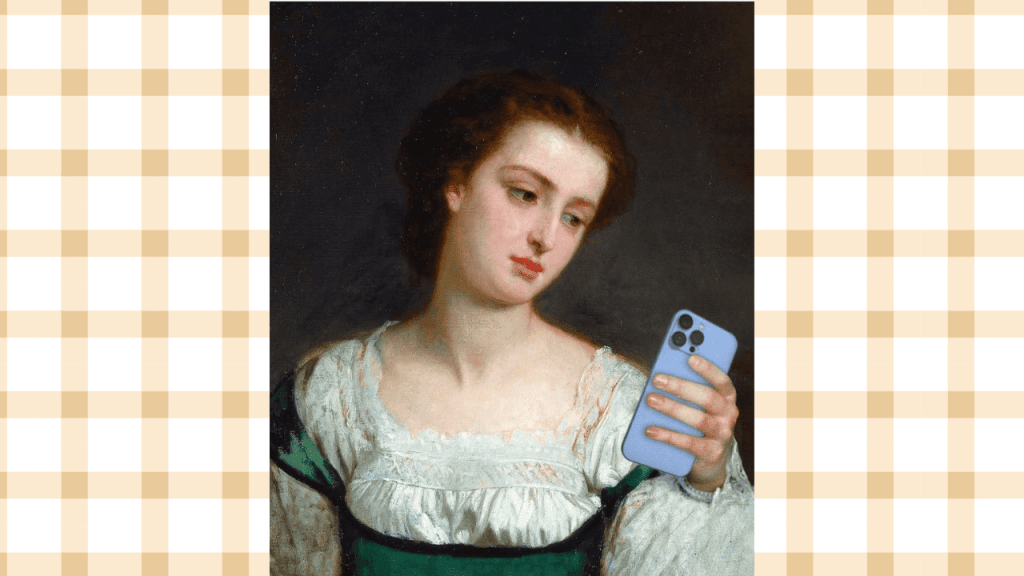
Cover image from Pinterest, inspired by Art Director Olivia Muss’s project “Museum of Selfies” from the National Gallery of Denmark in Copenhagen.


Leave a Reply